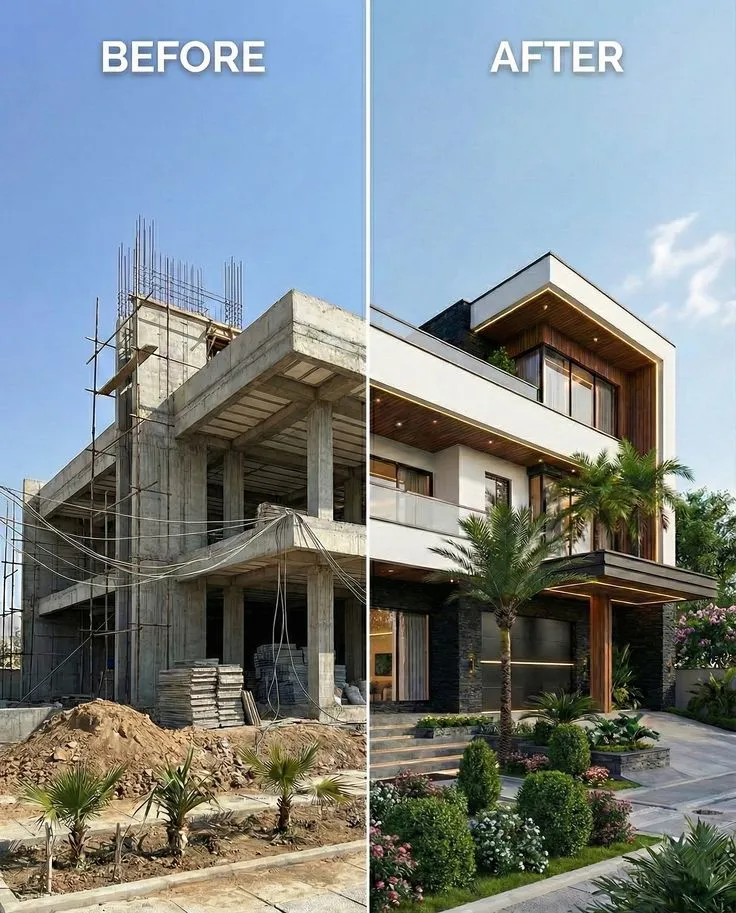
A building exterior has to do several jobs at once. It creates the first impression of a project, responds to its surroundings, communicates the character of the architecture, and gives clues about what happens inside. Yet façade decisions are often made while a project is still changing. Materials are not fully selected, landscaping is incomplete, and even the relationship between solid and glazed areas may still be under discussion.
This is where an AI architecture generator can become useful as an early visual exploration tool. Instead of waiting until every rendering detail has been prepared, architects can test how an emerging design might feel with different materials, lighting conditions, landscaping, and surrounding context. The aim is not to hand over façade design to AI. It is to see ideas early enough to question them before too much time has been invested in one direction.
Exterior Design Is More Than Choosing a Façade Style
It is easy to reduce exterior design to a collection of visual choices: brick or stone, light or dark, contemporary or traditional. Real projects are rarely that simple.
The façade is connected to the plan. Window positions respond to internal rooms. Entrances have to work with circulation. Materials need suitable detailing, and the building has to make sense in its climate and setting.
Even so, architects spend a great deal of time considering how these practical decisions come together visually.
A design may work perfectly well in plan but appear too repetitive from the street. Another scheme might have interesting geometry yet feel unnecessarily complicated once materials are introduced. Sometimes the problem is not the architecture itself but the way different elements compete for attention.
Being able to see a more developed version earlier can help identify these problems.
Start With the Question, Not the Render
One of the easiest ways to waste time with visual tools is to begin generating options without deciding what needs to be tested.
Suppose a team has developed the massing of a small apartment building. The geometry is mostly agreed, but there are still questions about the façade.
The team could generate twenty unrelated versions.
Or it could ask three clear questions:
- Does the building need stronger vertical emphasis?
- Which material palette makes the mass feel less heavy?
- How much landscape is needed around the entrance?
The second approach is far more useful.
Each image has a reason to exist, making it easier to compare the results. A rendering workflow then becomes part of the design discussion rather than a source of endless stylistic variations.
Material Choices Often Look Different at Building Scale
Architects are familiar with material samples, precedent photographs, and product boards. These references are essential, but they do not always reveal how a material will affect an entire elevation.
A brick that feels subtle in a sample can become visually dominant across several storeys. Dark metal may create a strong contrast around windows but make a large façade appear heavier than expected. Timber can introduce warmth, although using too much of it may completely change the character of the building.
With AI exterior rendering, a model export, sketch, photograph, or similar visual starting point can be explored with different material and atmospheric directions. AI Render Studio’s exterior workflow is designed for building façades, elevations, and street-view-style visualisations, with options to explore architectural style, lighting, landscaping, and surrounding context.
These studies should not be mistaken for final specifications. Their usefulness comes from helping the team decide which direction is worth developing in detail.
Daylight Does Not Tell the Whole Story
A building rarely looks the same throughout the day.
In strong daylight, façade geometry may be clearly visible. Deep window reveals create shadow, material textures are easier to read, and the overall massing can appear crisp.
At dusk, something different happens.
Interior lighting becomes part of the exterior composition. Entrances can become more prominent. Transparent areas stand out against solid walls, and lighting around paths or landscape features begins to influence how the building is perceived.
For hospitality, residential, retail, and mixed-use projects in particular, it can be helpful to think about these conditions before the final rendering stage.
A façade that looks convincing at noon may lose its hierarchy at night. Conversely, a simple daytime elevation may become far more interesting when internal activity is visible through glazing.
Exploring more than one lighting condition encourages designers to think about the building as something experienced over time, not as a single presentation image.
Context Can Change the Way Architecture Feels
A model displayed against a blank background makes it easy to study geometry, but buildings are never experienced that way in reality.
Trees partly obscure elevations. Cars introduce scale. People move through entrances. Adjacent buildings affect views and shadows. Pavements, roads, planting, and street furniture all influence how an exterior is read.
This means context should not be treated merely as decoration added at the end.
Consider a relatively simple three-storey building. In isolation, it may appear larger than intended. Once trees, neighbouring structures, pedestrians, and a realistic street edge are introduced, its perceived scale can change considerably.
The reverse can also happen. A façade that feels detailed enough in a blank model may appear flat once placed within a visually busy urban street.
AI-assisted exterior visualisation can help designers investigate this relationship earlier. AI Render Studio’s exterior workflow can introduce environmental elements such as vegetation, people, vehicles, and street context around an uploaded design image.
The generated surroundings still need to be treated carefully. They may communicate atmosphere, but they should not be presented as an exact record of real site conditions unless they genuinely are.
Why Simple Model Views Can Be Valuable Inputs
An early architectural model does not always need textures and detailed lighting before it becomes useful for visual exploration.
In fact, simple geometry can sometimes provide a cleaner starting point.
A white or lightly developed model keeps attention on the building’s basic form. The designer can then investigate different visual directions without spending hours constructing complex material setups for ideas that may soon be discarded.
AI Render Studio states that exterior visualisation can begin with viewport exports or screenshots from software such as SketchUp, Revit, Rhino, and ArchiCAD, as well as façade photographs and hand-drawn sketches.
That distinction matters. The workflow uses visual exports rather than replacing the modelling software itself.
The actual geometry should remain in the architect’s CAD, BIM, or 3D environment, where dimensions and design decisions can be controlled properly.
Attractive AI Details Need to Be Questioned
AI-generated visuals can introduce convincing architectural details. That is both useful and potentially misleading.
Imagine that a generated image adds deep timber fins around several windows. They may look excellent. They create shadow, break up a large elevation, and give the building a recognisable character.
But can they actually be built as shown?
How are they fixed?
How will they weather?
Do they interfere with views?
What happens near opening windows?
Are they affordable?
Do they meet relevant fire or maintenance requirements?
The render cannot resolve those questions.
Instead, the image has provided an idea: perhaps the façade would benefit from greater depth around the openings.
The architect can take that idea back into the real project and develop an appropriate solution.
This is an important habit when working with generative tools: extract the design principle rather than copying every generated detail.
Landscape Should Support the Architecture
Exterior renders can become overly dependent on greenery. A plain building suddenly looks inviting once mature trees, ornamental grasses, perfect lawns, and dramatic planting surround it.
There is nothing wrong with exploring landscape character, but it should remain credible.
A project in a dense city centre will have different opportunities from a suburban house. A drought-prone location cannot be treated in the same way as a wet climate. Large trees shown close to a façade may not be realistic if there is insufficient soil volume or space for roots.
It is therefore worth separating two questions:
Does this type of landscape improve the relationship between building and site?
and
Can this landscape actually be delivered here?
The first can be explored visually. The second requires proper landscape design, site knowledge, and technical consideration.
AI Can Help Before a Client Review
Exterior design conversations with clients can sometimes become difficult because architectural drawings and simple model views require interpretation.
A client may understand that the façade will use two materials but still struggle to imagine their overall effect. They may also find it difficult to judge whether a proposed entrance feels welcoming or whether a particular material makes the building appear too commercial.
A few carefully chosen visual studies can make these conversations more productive.
Rather than presenting ten loosely related options, an architect might show:
- one restrained material scheme;
- one warmer alternative;
- one version exploring stronger landscape integration.
The client now has meaningful differences to discuss.
They might prefer the warmth of the second option but the entrance treatment of the first. That response gives the design team information it can actually use.
Fast Iteration Still Needs Curation
Speed can be an advantage, but only when someone is willing to stop.
Generating additional variations is easy to justify. There is always another material to test, another lighting condition, another façade style, or another landscaping direction.
Eventually, however, more images create noise rather than insight.
Professional design requires curation.
An architect still has to decide which options respond to the brief, which ones respect the underlying concept, and which should never leave the internal design process.
This role becomes even more important when AI makes visual production quicker. The value of the designer shifts away from simply producing options and towards selecting, interpreting, and developing the right ones.
Traditional Rendering Remains Important
AI exterior visualisation and conventional rendering do not need to compete.
Traditional tools provide much greater control when exact materials, lighting, geometry, camera settings, and detailed presentation quality matter. AI Render Studio itself positions AI rendering particularly around concept visualisation and rapid iteration, while noting that conventional rendering can offer more precise control for final imagery.
A practical workflow may therefore use both.
AI-assisted images can support early exploration and design reviews. Once the project is more resolved, traditional visualisation can take over where precision becomes more important.
Different stages require different levels of certainty.
Keep the Real Building at the Centre
Perhaps the biggest danger of increasingly sophisticated rendering is becoming more interested in the image than in the architecture.
A spectacular sky, cinematic lighting, and lush landscape can make almost anything look compelling.
The building still has to work on an ordinary Tuesday morning.
People have to find the entrance. Windows need to serve real rooms. Materials have to age. Rainwater needs somewhere to go. The façade has to respond to its environment, budget, construction system, and regulations.
That is why AI-generated exterior images are strongest when they send the designer back to the project with better questions.
If the visual reveals a problem, investigate it.
If it introduces an interesting idea, test it properly.
If it simply makes an unresolved scheme look attractive, be willing to recognise the difference.
Conclusion
AI-assisted exterior rendering gives architects another way to investigate a building before committing to a highly detailed visualisation workflow. It can help compare materials, explore lighting, introduce context, improve client discussions, and reveal weaknesses that are difficult to notice in a basic model.
The real benefit is not producing more pictures. It is making each picture useful to the design process.
When architects begin with a clear question, carefully review what AI has added, and return worthwhile ideas to the actual project model, visualisation becomes a form of design exploration rather than decoration. The technology can make alternatives easier to see, but deciding which alternative belongs in the building remains the architect’s job.